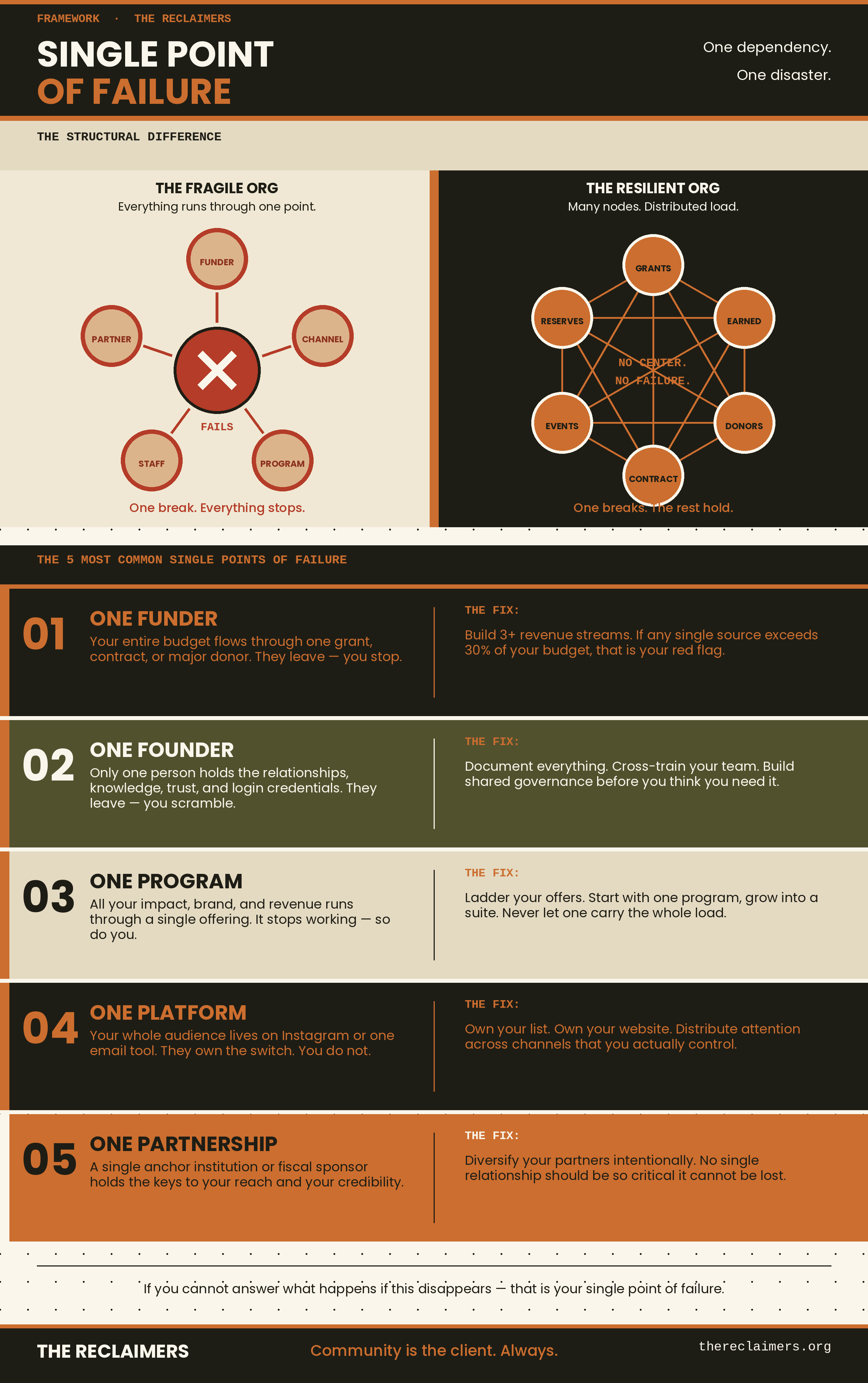
Grant Dependency Is a Risk Model, Not a Strategy
Nobody wakes up and decides to hand their life's work to a committee of strangers.
It happens the way most slow disasters happen — gradually, then all at once.
A program gets funded. A pilot succeeds. The community shows up. A foundation renews. The work expands. The need multiplies. The team grows. Payroll becomes real. Rent becomes real. The people you serve start depending on you the way they depend on the lights staying on.
And then one day, you're sitting in a conference room or staring at a spreadsheet at midnight, and you realize:
Everything — your ability to keep people housed, fed, safe, alive — hinges on a handful of people you will never meet, who can change their mind at any time, for any reason, and owe you absolutely nothing.
You didn't build a strategy.
You built a survival system.
And survival systems work — right up until they don't.
The Lie We Tell Ourselves About "Free Money"
The nonprofit sector has a word for grants: wins.
Grants are celebrated. They're announced on LinkedIn. Staff photos go up. Mission statements get refreshed. There's cake.
But nobody puts up a slide that says: "We just handed control of our organization's future to someone we've met twice."
Because that's also what happened.
Grants are not neutral resources. They come with gravity. Even when the funder is generous. Even when the relationship is warm. Even when the reporting is light. The moment you take a grant, your organization quietly begins reorganizing itself around a single guiding question:
What will funders fund?
That question sounds harmless. It isn't.
It rewires everything.
You start optimizing for approval, not impact. Your work becomes legible to philanthropy — which means it starts becoming less legible to your community. You learn which words unlock dollars. You learn which truths make people uncomfortable. You flatten real complexity into tidy narratives because real problems don't fit in logic models.
You build programs that are fundable — then spend years wondering why they can't sustain themselves. You get funded to launch. Not to maintain. Funded for innovation, not infrastructure. Funded for outputs, never for the operational capacity to actually deliver them. When the grant ends, you're holding a successful program with no engine behind it.
You become permanently reactive. Deadlines, cycles, renewals, pivots, reporting windows, site visits. If your operating rhythm is dictated by other people's calendars, you cannot build momentum. You can only chase it — always slightly behind, always slightly breathless.
You normalize instability as the price of doing good. Two-year funding. One-year funding. Six-month bridge grants. You plan in fragments. Your team lives in uncertainty. Your nervous system never fully stands down. That isn't just stressful. It's structural — and it burns people out not because the work is hard, but because the ground never stops shifting beneath their feet.
When "Resilient" Just Means "Better at Absorbing Damage"
Here's something the sector rarely admits out loud:
Many organizations that call themselves resilient aren't resilient at all.
They're just experienced at crisis.
They've become expert at writing the emergency grant. At making do. At running lean until lean becomes dangerous. At holding things together through sheer force of personal sacrifice — directors working evenings and weekends, staff carrying caseloads no one should carry, leadership absorbing the psychological weight of keeping everyone calm while privately bracing for collapse.
That's not resilience. That's a workforce that has been conditioned to absorb damage on behalf of a broken funding model.
And here's the part that should make you furious:
The people closest to the most urgent problems are kept closest to the most precarious funding.
It's not an accident. It's a feature.
When your organization is perpetually under-resourced, you can't build power. You can't say no. You can't organize. You can't set terms. You're too busy surviving to become a threat to the systems that created the problems you're trying to solve.
Grant dependency isn't just a financial risk. It's a power structure — and it is not neutral about who wins.
The "But We Can't Charge for This Work" Trap
If the phrase earned revenue made something tighten in your chest just now, I want you to sit with that for a moment.
Because that feeling — that instinct that charging for your work is somehow a moral failure — didn't come from nowhere. It was cultivated. It's been taught, modeled, and reinforced by a culture that tells mission-driven leaders that struggle is a sign of integrity, that scrappiness is a virtue, and that wanting a real budget makes you suspect.
The system benefits from that belief.
Because leaders who believe they're not allowed to build real revenue are leaders who stay dependent. Leaders who stay dependent stay controllable. Leaders who stay controllable don't build power.
Here's the reframe I want to offer you:
Sustainability is not the opposite of integrity. Sustainability is how integrity survives.
You don't have to become corporate. You don't have to compromise your values. You don't have to turn your community into a product.
You have to become the kind of organization whose lights stay on.
Because if your work disappears when the next funding cycle turns — who does that protect? Not your community. Not your team. Not the mission you've built your professional life around.
The moral failure isn't building financial resilience.
The moral failure is building something fragile and calling it pure.
What a Single Point of Failure Actually Feels Like
Let me be concrete about what grant dependency looks like structurally — because sometimes it helps to see the math.
A grant-dependent organization typically looks like this:
Revenue concentrated in three to five sources
Cash flow delayed, seasonal, or reimbursement-based (meaning you spend before you receive)
Staff hired with restricted dollars that expire on a fixed date
Infrastructure perpetually underfunded because no one will fund "overhead"
Decision-making conservative to the point of paralysis because the downside of a wrong call is catastrophic
The result is an organization that is simultaneously over-extended and under-resourced. Doing too much with too little, too fast, with too few systems, sustained by people who care too much to stop.
If one funder changes priorities — your work collapses. If a new program officer arrives with different instincts — your team shrinks. If the political climate shifts — your "safe" funding category evaporates. If you can't prove impact in their language — your outcomes stop counting.
You call this "resource development."
But most days, what it is — honestly, if we name it — is risk management. Permanent, exhausting, mission-critical risk management, dressed up in grant writer's language.
From Dependency to Leverage: What the Shift Actually Looks Like
Moving off grant dependency doesn't mean abandoning grants. Grants can absolutely remain part of a healthy funding mix.
The shift is this: moving from grants as a lifeline to grants as a tool.
That's not philosophical. It's structural. Here's what it looks like in practice.
Earn revenue in ways that match your values. Earned revenue doesn't have to be predatory — it can be redistributive.The principle is simple: charge the systems with budgets. Subsidize the communities without them. That might look like fee-for-service with sliding scale structures, training and consulting for institutions that should be paying for your expertise, licensing content or toolkits that let your knowledge travel without burning out your staff, or membership models that fund ongoing organizing work.
Design a funding mix that cannot collapse from one loss. The goal isn't more money — it's less fragility. A mix of grants (restricted and unrestricted), monthly community supporters, earned revenue, and thoughtfully structured major gifts means that when one stream dips, the organization stays upright. That's not just finance. That's strategy.
Stop treating operations as an unfunded side quest. Operations aren't overhead. They are continuity. They are how you keep promises. They are the difference between a program that lasts and a program that collapses when one key person burns out. The spine of a real organization includes funded systems, staff retention, data infrastructure, financial planning, and communication capacity. None of this is "admin." All of it is mission.
Get clear on what you offer — and to whom. Many organizations don't have a revenue problem. They have a translation problem. They do extraordinary work and describe it in apologetic, inside-baseball language that makes it nearly impossible for someone with a budget to understand why they should pay for it. Clarity creates conversion. Conversion creates cash flow. Cash flow creates capacity. Capacity creates impact. This isn't marketing. It's mission infrastructure.
A Diagnostic You Should Sit With
Before you move on, I want to ask you something. Not rhetorically. Actually.
If your largest funder disappeared next quarter — what breaks first?
Do you have any revenue you actually control — reliable, repeatable, values-aligned?
Can you say no to money that compromises your work?
Are you building assets — systems, relationships, content, partnerships — that compound over time? Or are you rebuilding from scratch every two years?
Does your model protect the people doing this work? Or does it quietly grind them down while asking them to smile about it?
If those questions landed somewhere uncomfortable, that discomfort is information.
It doesn't mean you've failed. It means you've been strong inside a fragile structure for a long time, and your nervous system knows it — even if your grant reports look fine.
The Work Deserves a Model That Can Hold It
Here's what I believe:
If your work is urgent — and it is — then it deserves infrastructure that matches that urgency.
Not infrastructure that looks good in a report.
Infrastructure that holds.
Infrastructure that protects your team.
Infrastructure that gives you the power to say no to misaligned money and yes to your community.
Infrastructure that doesn't flinch at a funding cycle.
Because the people you serve don't get to wait while you figure out the next grant.
They're here now.
Your work is now.
Build something that lasts.
At The Reclaimers, we help ethical nonprofits and community-rooted small businesses build sustainable impact models, clear messaging, and revenue systems that convert — so your work is never one grant cycle away from collapse. We offer sliding scale and are building an Access Fund to bring real support to leaders who've been locked out of "good help" for too long.
If you're ready to move from survival to strategy — book a free growth call.