
The Impact MVP: How to Pilot Without Burning Out Your Team
The idea is strong. The room is excited. The need is real.
So the organization names the initiative, builds the timeline, drafts the staffing plan, and prepares for launch.
It looks like momentum.
It isn't. It's overcommitment dressed up as progress.
Months later, the program is live — but the team is drained. Participation is softer than expected. The model is harder to execute than it looked. And underneath the exhaustion is the question nobody wants to say out loud:
Did we build the right thing too fast?
That question is worth sitting with. Because most mission-driven organizations aren't struggling because they lack vision. They're struggling because they built at full scale before they had the proof, the capacity, or the systems to hold what they launched.
That's the problem an Impact MVP is designed to solve.
The issue isn't ambition. It's sequence.
Communities need organizations that can imagine what doesn't exist yet. Big vision matters.
But in this sector, there's constant pressure to move in the wrong order.
Hire before you validate.
Scale before you learn.
Announce before you know whether the model actually works.
When that happens, the people absorbing the cost aren't distant funders or detached stakeholders. It's the staff member holding too much. The founder trying to keep the whole thing afloat. The volunteer who burns out. The community member who shows up hopeful and leaves underwhelmed.
This is a build-order problem, not a passion problem.
What we mean by an Impact MVP
MVP usually stands for Minimum Viable Product — the startup practice of building the simplest version of something that lets you test whether it works before you pour more resources into it.
At The Reclaimers, we adapt that logic for mission-driven work.
An Impact MVP is the leanest version of a program, initiative, or service that lets you test your core assumption without overextending your team, your budget, or your community's trust.
It's not a watered-down version of the mission. It's a disciplined version of the launch.
In practice, that might look like:
Running one small cohort before building the full program
Borrowing space before signing a lease
Delivering a service manually before building out infrastructure
Piloting a short-term version before fundraising around a long-term one
Testing one partnership before making it a public strategy
This isn't playing small. It's protecting the mission from avoidable waste, burnout, and misalignment.
Why organizations skip this step anyway
Most mission-driven teams know, on some level, that they should test before they scale. They still skip it. Here's why.
The sector rewards the full vision, not the honest test. A proposal promising sweeping impact sounds more fundable than one that says "we're going to pilot this carefully and iterate." So organizations overstate scale before they have proof — and then feel pressure to deliver the bigger version before the smaller one was ever properly tested.
Urgency gets confused with speed. When people need support now, slowing down feels irresponsible. But there's a difference between urgency and rushing. A program that collapses under poor design or unrealistic assumptions doesn't serve people faster. It serves them worse. Testing isn't delay. It's stewardship.
Starting lean can feel less credible. A lot of organizations have internalized the idea that small means less legitimate. But most durable work starts with something quieter, smaller, and less polished than the final version. What makes it credible is whether it actually works.
Nobody tells the story of the pilot. Organizations share the polished origin story — not the rough first cohort, the gaps, the assumptions that didn't hold. So everyone assumes they're supposed to get it right on the first full launch. They're not.
What a strong pilot actually looks like
A good Impact MVP doesn't need to be elaborate. It needs to be intentional.
Name the assumption underneath the idea. Every initiative is built on a belief: If we provide this, to these people, in this way, this outcome will happen. Name that belief clearly — because that's what the pilot is actually testing. If you can't name the assumption, you're not ready to build.
Design the smallest version that can test it. The point of a pilot isn't to simulate the full future program. It's to test the most important thing first. That may mean fewer participants, a shorter timeline, more manual processes, or a borrowed space. The pilot doesn't need to be fully scaled. It needs to be useful.
Put real boundaries around it. One of the most common mistakes is calling something a pilot while treating it like an open-ended launch. Set the duration. Set the resource cap. Set the evaluation date before it begins. Without defined edges, the pilot quietly becomes an under-resourced program — and your team pays the price.
Decide in advance what counts as learning. Before launch, define what real signals look like. Not surface-level excitement. Did participants come back? Did the value land the way you expected? Did delivery require far more labor than anticipated? A pilot is only useful if it helps you make a better decision.
Protect the debrief. This is the step that gets skipped most. The pilot ends, everyone is tired, other priorities move in, and the organization says it will revisit the learning later. Later never comes. Schedule the debrief before the pilot starts. Treat it like a deliverable. Then make a decision: scale, revise and test again, or stop. All three are valid outcomes.
What this looks like in practice
A workforce development program doesn't start as a 24-person, multi-month initiative. It starts as a shorter cohort with a smaller group — to test curriculum fit, facilitation, and partner follow-through.
A food access initiative doesn't begin with a signed lease and a full operating model. It begins with a recurring meal in borrowed space — to test turnout, flow, volunteer sustainability, and community response.
A consulting organization doesn't build out a full new service line before delivery is pressure-tested. It pilots with one or two clients, learns what creates value, and refines before scaling.
None of those examples are about staying small forever. They're about building responsibly now so the work can hold later.
Lean is not small forever. It's smart right now.
An Impact MVP is not an excuse for endless indecision. It's not fear dressed up as strategy.
It's disciplined learning in service of durable growth.
Your team deserves a launch that doesn't hollow them out. Your community deserves a model that functions when they show up. Your mission deserves more than a beautiful idea with no proof underneath it.
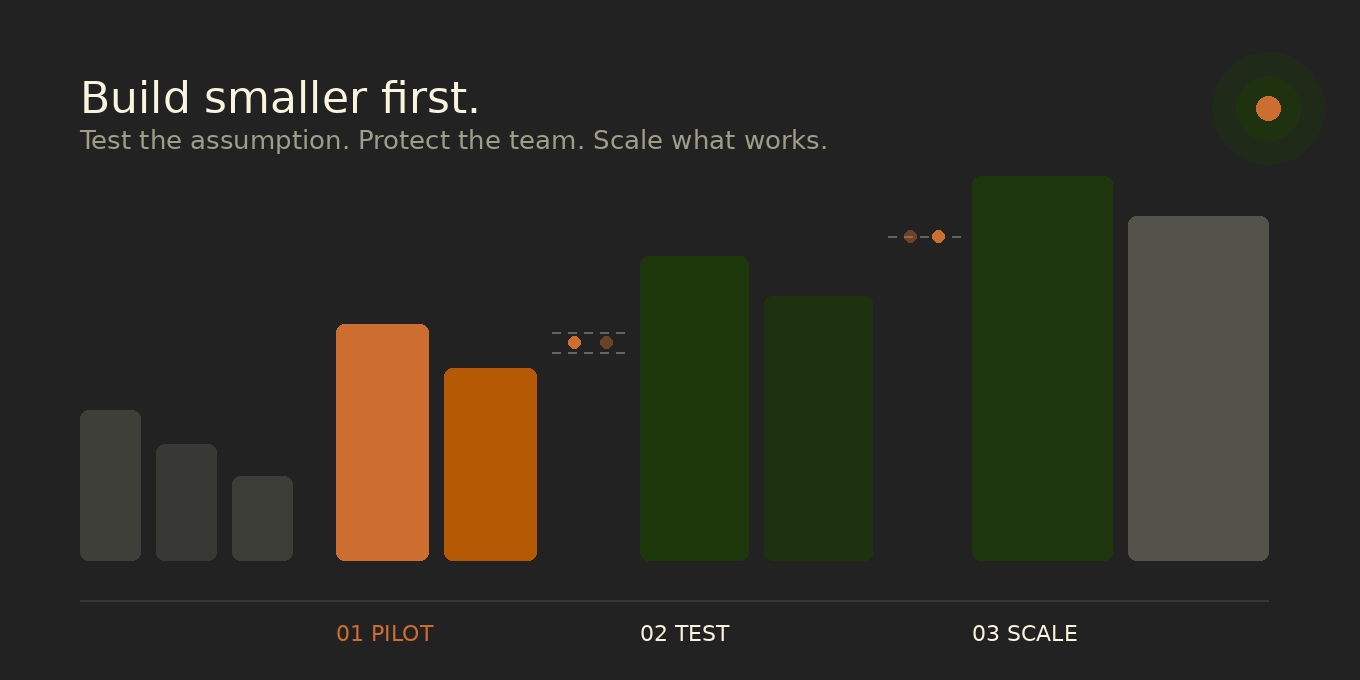
Start with the smallest version that can teach you something true. Protect your people while you learn. Scale what actually works.
That's not a lower bar. That's a more responsible one.